KI-Agenten für Ärzte und Praxen
Welche KI-Agenten Arztpraxen und medizinische Einrichtungen wirklich entlasten – von der Terminvergabe bis zur Patientenkommunikation.

Shopify has become one of the leading e-commerce platforms worldwide. Not only because of the ease of use, but also because of the ability to scale individually and strategically. Even with the entry-level Shopify Basic package, you can operate a professional online shop. But with growth, requirements are increasing. At some point, the question comes up: Is the Basic package still enough or does it make sense to switch to Shopify Plus?
You shouldn't make this decision based on instinct. The switch is not only worthwhile because of the range of functions, but because your business model has changed. In this article, you will find a clear distinction between the two variants and tips on what really matters.
Shopify Basic is ideal for smaller stores that can still keep their processes under control. You get two user accounts, unlimited products, a solid checkout, discounts, voucher features, and the ability to flexibly integrate payment providers. Simple reports are also available.
With the right apps, many things can be retrofitted — such as SEO tools, shipping solutions or tax automation. But at some point, you'll run into technical or structural limits. At the latest when you operate several sales channels at the same time or can no longer manually map processes, the basic package is no longer sufficient.
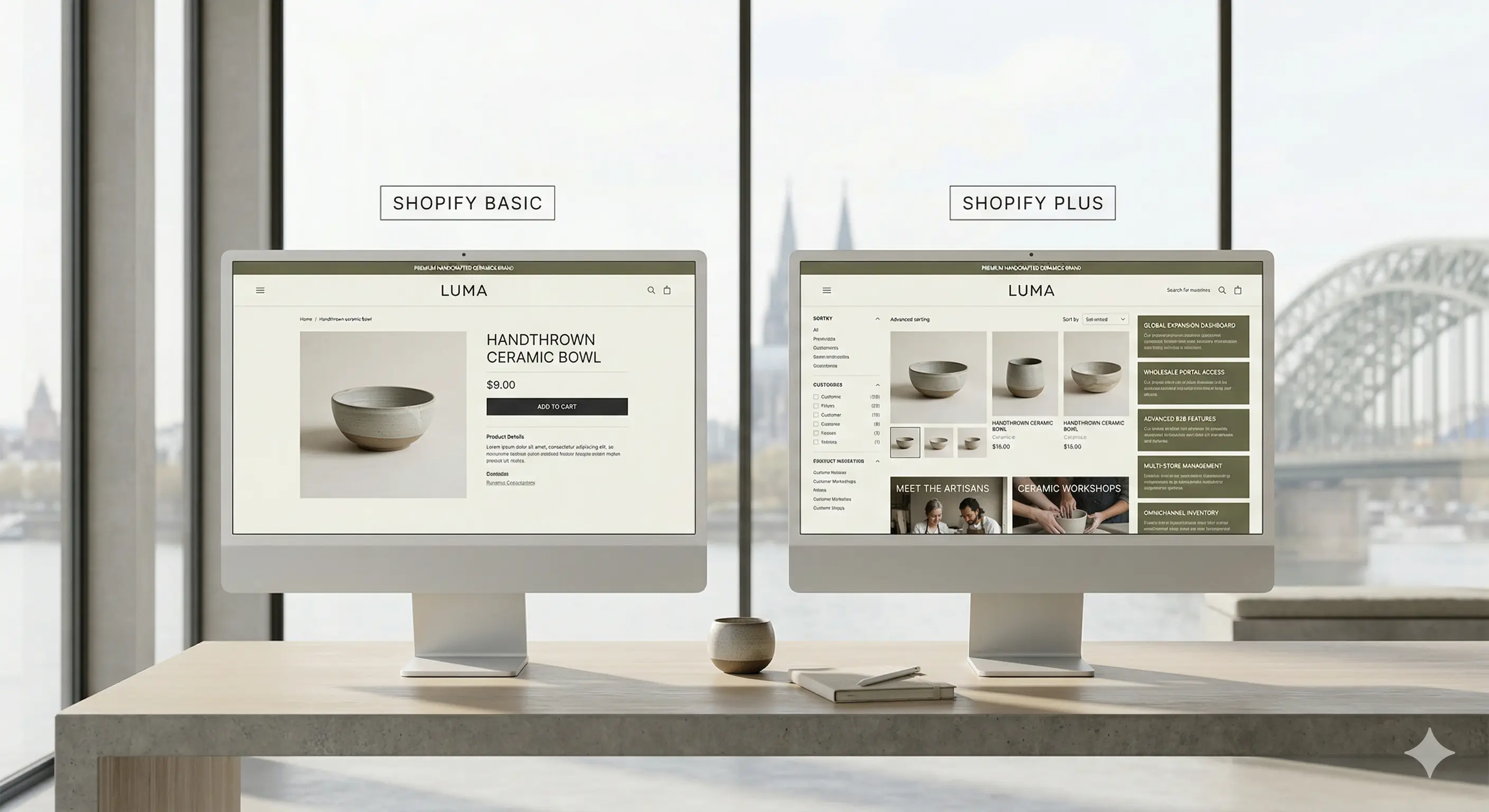
Shopify Plus isn't an extended version of Basic, but a new technical approach. The platform is designed to manage multiple shops, handle high traffic, and automate business processes. It is not about more functions, but about strategic ability to act.
Plus users benefit from significantly greater API freedom, customizable checkout, access to Shopify Flow, and support from a dedicated launch engineer. It is also possible to manage up to ten storefronts at the same time. Anyone who sells internationally, needs different languages or currencies benefits significantly here.
Shopify Plus is worthwhile from an annual turnover of around 800,000 to 1,000,000 euros. But it's not just turnover that counts. The internal structure is also decisive. If you depend on automation, are planning an ERP integration or work with PIM systems, you are reaching natural limits with Basic.
Conversely, anyone with a lean product portfolio, few international ambitions and no complex checkout requirements can work efficiently for a long time with Shopify Basic. The smaller version is also absolutely sufficient for entry-level or test markets.
One aspect that is often overlooked is the checkout. With Shopify Basic, this can only be changed to a limited extent. Shopify Plus, on the other hand, gives you access to the checkout code. This gives you the opportunity to react specifically to customer behavior.
You can only display certain payment methods to specific countries, map individual discount logics, or implement A/B tests. All of this has a direct impact on your conversion. And not only saves costs in the medium term, but also strengthens customer loyalty.
A real case for Shopify Plus is access to Shopify Flow. This automation service makes it possible to define processes without additional tools. For example, as soon as an item reaches an inventory of less than ten, you will receive an internal notification.
Such workflows can be individually adapted and noticeably relieve your team. This pays off immediately, especially for recurring tasks such as tagging, status notifications or inventory reconciliation.
Developer-friendly is another strong case for Shopify Plus. While Basic users must work with API limits and access limits, Plus allows significantly more extensive connections to be implemented. This applies in particular to ERP systems, shipping service providers or external marketing tools.
For example, if you need automated data exchange between your shop, accounting and a warehouse service provider, Shopify Plus has a clear advantage. Without such interfaces, your team would still have to manually map many processes — and that is exactly what quickly becomes a bottleneck as sales increase.
Shopify Plus allows up to ten parallel storefronts. These can not only be differentiated linguistically and creatively, but can also be adjusted for tax and legal purposes. A German shop can therefore display a completely different pricing structure and different payment methods than a French or US shop.
Shopify Plus also offers extensive B2B functionalities — such as individual price lists, approval workflows for orders or customer-specific discount scales. Anyone who is active in wholesaling or wants to individually serve commercial customers is significantly better off with Plus.
There are good reasons to stick with Shopify Basic. If your business model is simple, your customer base remains manageable and you can do without external tools, then the basic package is just right for you. Many successful niche brands have also been working with Basic for years — and doing well with it.
However, pay attention to whether at some point you will only solve existing processes through detours or workarounds. Because as soon as these detours take more time than an upgrade, the point is reached where Shopify Plus makes more sense. If you're currently at a point where Shopify Basic no longer covers all requirements, then check which features you would really use.
Techwerk supports customers through precisely these transitions — with technical know-how, a clear strategy and an honest assessment. If you're unsure whether switching to Shopify Plus is the right move for you, it's worth having an open conversation.
From custom software to powerful marketing, we empower your business with innovative technology and strategic design.
We have received your request and will get back to you within 24 hours at the latest with an answer